Which Meteora Monasteries Are Best to Visit?
Wondering which Meteora monasteries to visit? Here are the best picks for half-day and full-day itineraries, plus which monastery suits your interests and mobility.
Grand Meteoron and Varlaam remain the strongest first pair. If time or transport complicates that plan, compare local, Athens, and two-day formats while confirming the monastery lineup for your date. Choose A Tour For This Itinerary
Last updated: June 28, 2026
All Six Monasteries: Quick Reference
| Grand Meteoron | c. 1340 | Male | ~300 | Tuesday | History, scale, museum, views |
| Varlaam | 1517 | Male | ~195 | Friday | Frescoes, winch tower, museum |
| Roussanou | 1545 | Nunnery | ~130 | Wednesday | Exterior, photos, honey shop |
| Holy Trinity | 1458 | Male | ~140 + walk | Thursday | Drama, isolation, Bond film site |
| St. Stephen’s | 12th c. | Nunnery | 0 (bridge) | Monday | Accessibility, Byzantine royalty |
| St. Nicholas Anapafsas | 14th c. | Male | ~100 | Friday | Art, quiet, Theophanes frescoes |
Entry fee: €5 per adult, cash only. Children under 12 free. All six open Saturdays and Sundays. Summer hours Apr 1-Oct 31; winter hours Nov 1-Mar 31. Verify locally before visiting as hours change without notice.
After shortlisting monasteries by steps and interests, compare local, Athens, and two-day formats if transport between the rocks affects your plan.
Which Meteora Monasteries Are Open to Visitors?
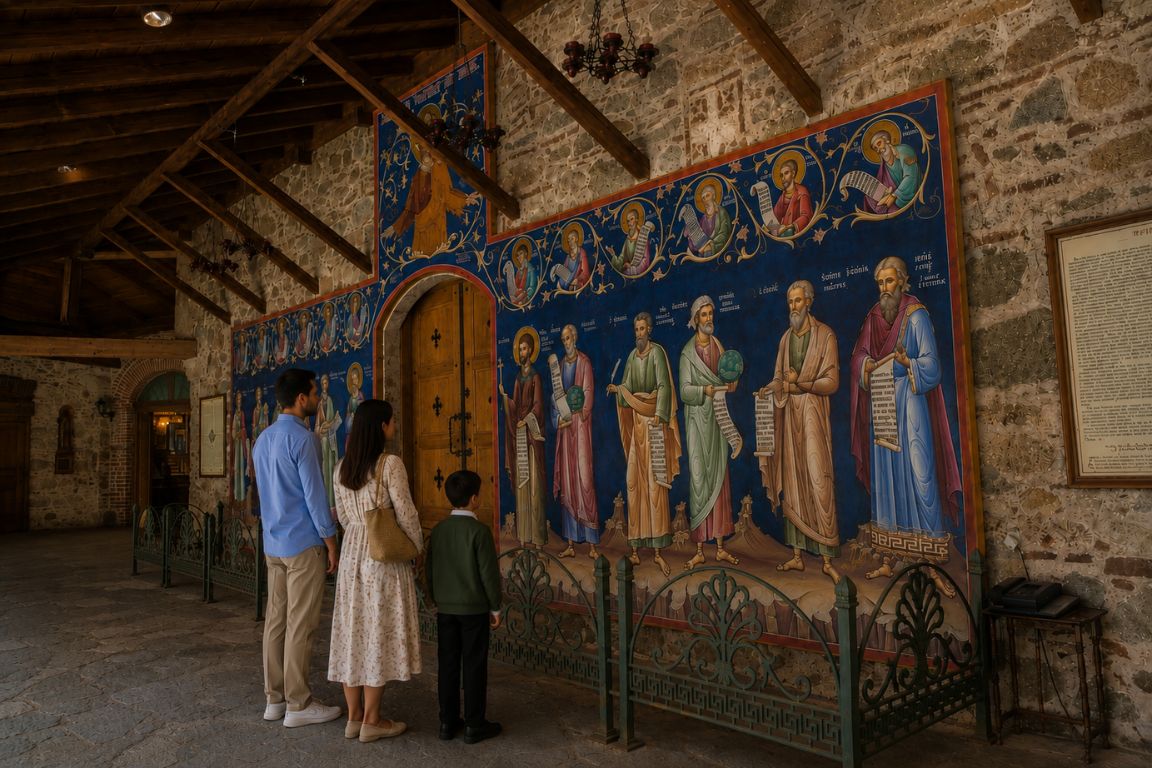 Six of the original 24 monasteries at Meteora are active and open to the public: Grand Meteoron, Varlaam, Roussanou, Holy Trinity, St. Stephen’s, and St. Nicholas Anapafsas. Each charges €5 per adult, cash only, with children under 12 entering free. All six are open every Saturday and Sunday. On weekdays, each monastery is closed on a different day – the detail that catches most independent travelers out.
Of the 18 monasteries no longer standing, most fell into ruin after the 17th century as the monastic population declined. A handful of rock towers still carry crumbled walls you can spot from the viewpoints – the remnants of a complex that was, at its 16th century peak, one of the most significant monastic centers in Orthodox Christianity, second only to Mount Athos.
The six that remain are genuine working monasteries, not museums. About 17 monks and 50 nuns live across the six sites. Religious services take place regularly. Photography inside the churches is prohibited. The atmosphere is respectful, and the dress code is enforced without exception: long trousers for men, long skirts for women. Wrap-around skirts are available free at most entrances for women who arrive in trousers, but it’s worth bringing your own in summer when the provided ones are heavy.
How many to visit depends on your time and energy. Three or four in a full day is comfortable. Two is the right number for a half-day visit or a day trip that includes travel from Athens. Trying to rush all six in a single summer day is possible but leaves most people feeling like they rushed what should have been unhurried. The fourth monastery of a long hot day tends to look remarkably similar to the second.
The journey is part of the experience. Here’s how to make the most of a Meteora day trip from Athens without burning half your day on bad planning.
| Half day (3-4 hrs) | Grand Meteoron + Varlaam | Avoid Tuesday (Grand Meteoron closed) or Friday (Varlaam closed) |
| Full day (6-8 hrs) | Grand Meteoron + Varlaam + Roussanou + Holy Trinity | Saturday or Wednesday are safest for this combination |
| Two days | All six, spread across two mornings | Leave afternoons for viewpoints, hiking, and Kastraki village |
| Mobility-limited visitor | St. Stephen’s first, then Roussanou | St. Stephen’s has no stairs; Roussanou has moderate steps with handrails |
If you’d rather hand the day’s logistics to a guide who already works around closure days, see the private monasteries tour (six hours, local guide).
The answer depends on more than you’d think. Here’s how many days you need in Meteora tours so you don’t leave wishing you had more time.
Before choosing how many active monasteries to enter, review the clothing requirements and other practical dress rules for visitors.
Grand Meteoron (Great Meteoron) – The Oldest and Largest
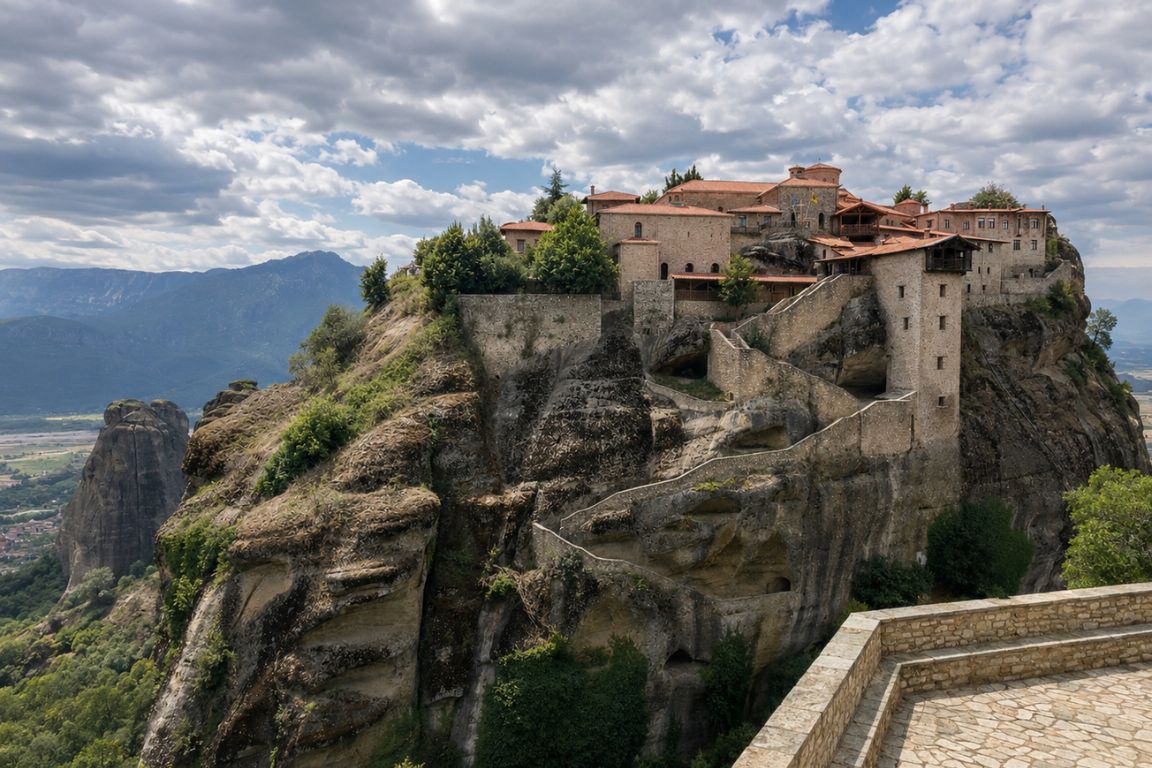
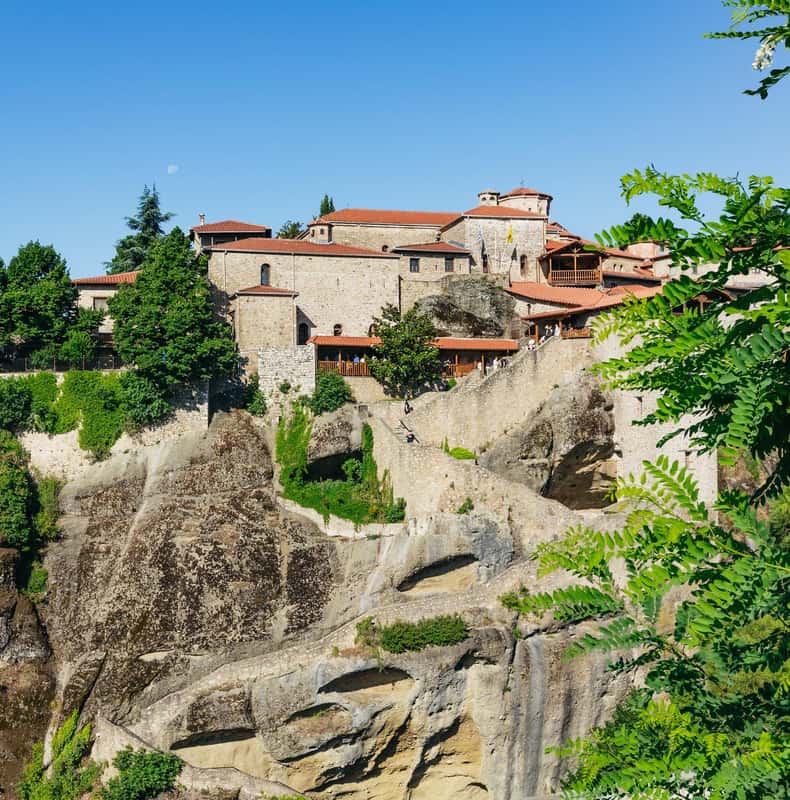
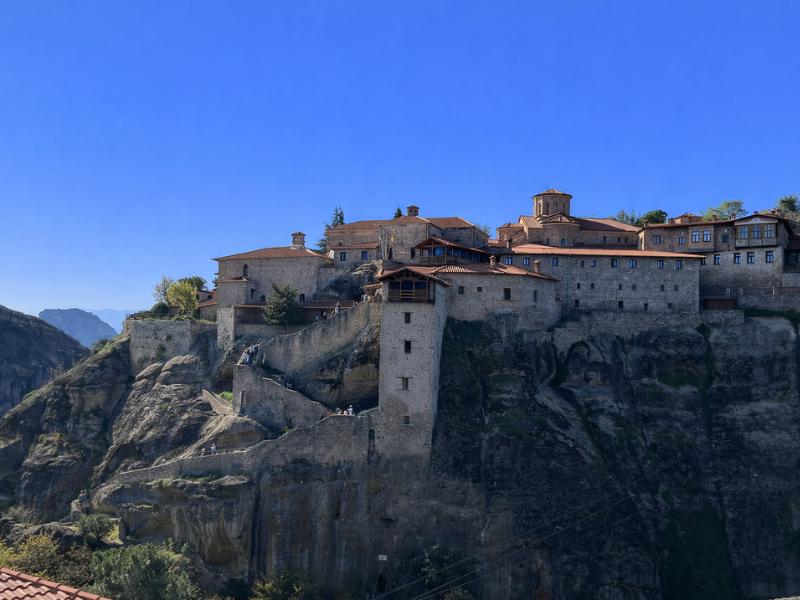
Grand Meteoron is the monastery that defines Meteora. Founded around 1340 by Saint Athanasios the Meteorite on the highest rock in the complex at 613 meters, it is the oldest, the largest, and the one that contains the most to see: a full museum, frescoes painted over multiple centuries, an ancient kitchen black with centuries of cooking smoke, an ossuary, a wine cellar, and views that on a clear day reach Mount Olympus on the northern horizon.
The approach from the parking area involves roughly 300 stone steps carved into the rock face, with rest platforms along the way. It’s a steady climb rather than a brutal one, and the elevation gain earns you a different relationship with the landscape than you get from the viewpoints below. By the time you reach the entrance gate, the Thessalian plain is already spread out beneath you in a way that makes everything feel smaller.
Inside, the main church is dedicated to the Transfiguration of Christ and decorated with post-Byzantine frescoes that are considered among the finest examples of the style in Greece. The colors are deep and readable even in the chapel’s interior light. The founders of the monastery, Saint Athanasios and his successor Saint Joasaph, are buried here and still venerated by Orthodox pilgrims. Their tombs are in the narthex, and you will see candles lit near them at almost any hour the monastery is open.
The museum occupies the old refectory and covers the monastic community from its founding through to the 20th century. It holds illuminated codices, carved wooden crosses, bishops’ vestments, and a collection of religious icons spanning several centuries. The ancient kitchen next door has never been whitewashed or cleaned of its smoke patina, making it one of the most atmospheric rooms at Meteora. The wooden ceiling is almost entirely black. The original cooking implements are still on their hooks.
The ossuary is a small room where the skulls of former monks are displayed on shelving. This is a standard feature of Orthodox monastery tradition rather than anything morbid – the same practice exists at monasteries across Greece and the Balkans. The wine cellar below the main complex still holds a large storage barrel. Neither of these rooms is prominent on the monastery circuit, but if you take your time and look beyond the main church courtyard, both are findable.
Grand Meteoron is busiest between 10:30 and 13:00 when the Athens day-tour coaches are on site. Arriving at 09:30 on the dot gives you the courtyard in something close to quiet. Closed Tuesdays in summer; also closed Wednesday and Thursday in winter.
Meteora is more than just monastery hopping. Here’s a full guide on what to do in Meteora tours covering hiking trails, viewpoints, and experiences most visitors overlook.
| Founded | c. 1340 by Saint Athanasios the Meteorite |
| Elevation | 613 m above sea level (highest of the six) |
| Steps | ~300 (with rest platforms) |
| Entry fee | €5 per adult, cash only |
| Summer hours | 09:30-15:00, closed Tuesday |
| Winter hours | 09:30-14:00, closed Tuesday, Wednesday, Thursday |
| Don’t miss | Ancient kitchen, ossuary, museum, tombs of the founders |
| Best combined with | Varlaam (5 minutes by car from the Grand Meteoron car park) |
If Grand Meteoron is your priority, use the opening-day planning guidance to build the weekly route and choose an alternative monastery.
Varlaam – The Best Interior in Meteora
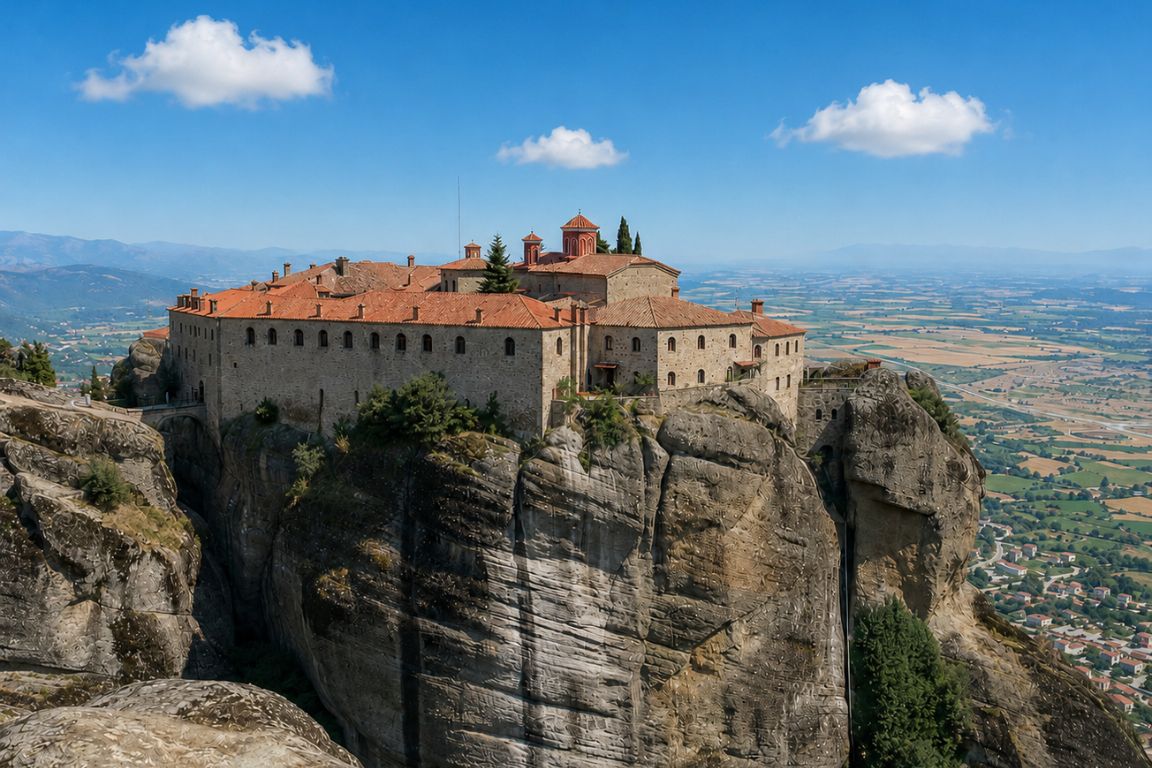
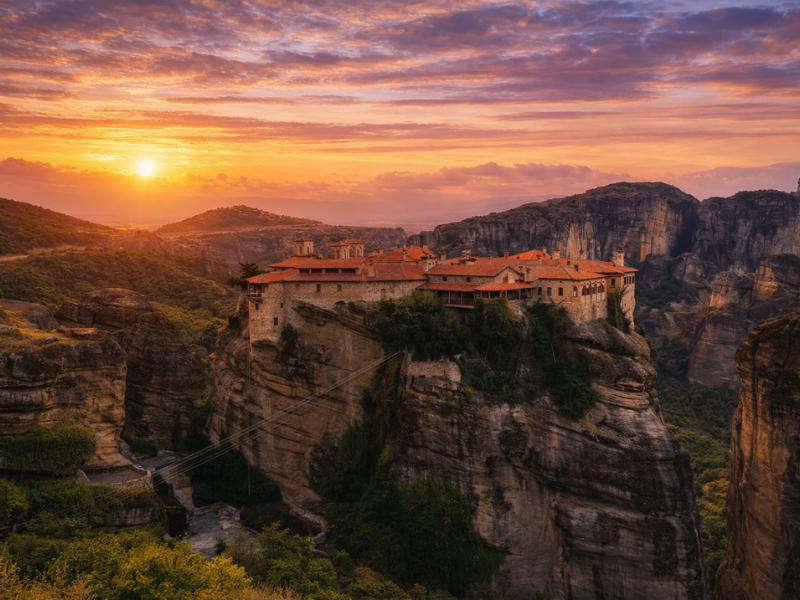
Varlaam has the finest interior of any monastery at Meteora. The frescoes in the katholikon, painted by master iconographer Frangos Katelanos of Thebes in 1548, are extraordinary in their color, detail, and state of preservation. The museum preserves the original rope-net winch tower from 1536 – the one the abbot famously said he would only replace “when it breaks” – along with a 12,000-liter oak barrel and footage of early 20th-century monks being lifted in nets. For most visitors, Varlaam is the single most rewarding interior of the six monasteries.
The monastery was founded in its current form in 1517, though a hermit named Varlaam had settled the rock more than 150 years earlier, building three tiny chapels and a water tank before dying alone on the summit. Two wealthy monk-brothers from Ioannina, Theophanes and Nektarios Apsarades, climbed up in 1517, cleared the ruins, and built what stands today. According to the monastery’s own account, they first had to drive out a monster living in a cave at the summit, which may be the only monastery founding story in Greece that involves pest control of the supernatural variety.
The climb to Varlaam takes about 195 steps, less demanding than Grand Meteoron’s 300. The winch tower is visible from the approach road before you begin the ascent: a stone turret projecting from the cliff face with the original rope mechanism still inside. The basket that once carried monks and building materials up the vertical face is preserved in the museum. It has a look of practical improvisation about it, nothing ornate, just a large net bag on a rope, which is presumably exactly what it was.
Inside the katholikon, the frescoes cover every wall, arch, and ceiling surface. Katelanos worked here from 1548, and additional painters completed the narthex in 1566. The visual program follows post-Byzantine convention – scenes from the life of Christ, martyrdom cycles, portraits of saints, but the quality of execution is exceptional by any comparison. The Pantocrator in the dome dome is one of the most impressive ceiling paintings at Meteora. Bring a small torch if you want to see the upper registers clearly; the interior light is dim at the edges.
The museum occupies the old refectory, a barrel-vaulted space that is itself architecturally interesting. The collection includes relics of Saint Andrew and Saint John the Baptist, carved wooden crosses, embroidered ecclesiastical vestments, and over 300 manuscripts copied by monks over several centuries. A small screen in the museum shows archive footage from the early 20th century of monks and visitors being hauled up the cliff face in nets. It is genuinely unsettling to watch, which is probably why they show it.
The 12,000-liter oak wine barrel in the cellar is the other detail that stays with people. The monasteries were largely self-sufficient communities that produced wine, kept livestock in the valley below, and pulled supplies up by rope. The barrel is evidence of that scale. It is not small.
| Founded | 1517 by Theophanes and Nektarios Apsarades (original hermit: Varlaam, c.1350) |
| Steps | ~195 |
| Entry fee | €5 per adult, cash only |
| Summer hours | 09:00-16:00, closed Friday |
| Winter hours | 09:00-15:00, closed Tuesday, Wednesday, Thursday |
| Don’t miss | Katelanos frescoes (1548), winch tower, archive footage, 12,000-liter barrel |
| Best combined with | Grand Meteoron (5 minutes by car or 15-min walk from parking) |
If you only have time for two monasteries, these are the two. They sit close enough to visit in sequence without backtracking, and together they cover the oldest, the largest, and the best-decorated interiors at Meteora. Want help fitting both into a half-day? The early-morning small-group tour runs four hours with a local guide.
Discover a morning built around three monastery interiors, with a local guide connecting the history between stops and minibus travel through the rocks.
Roussanou – The Most Photogenic
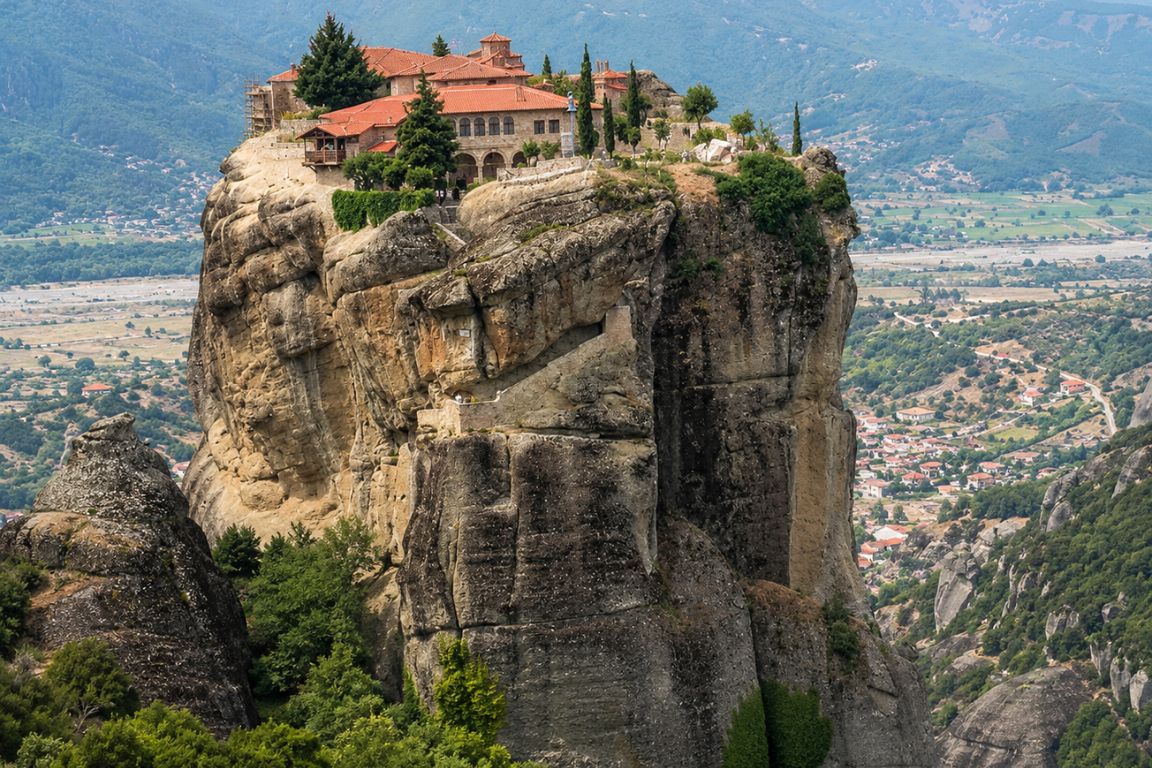
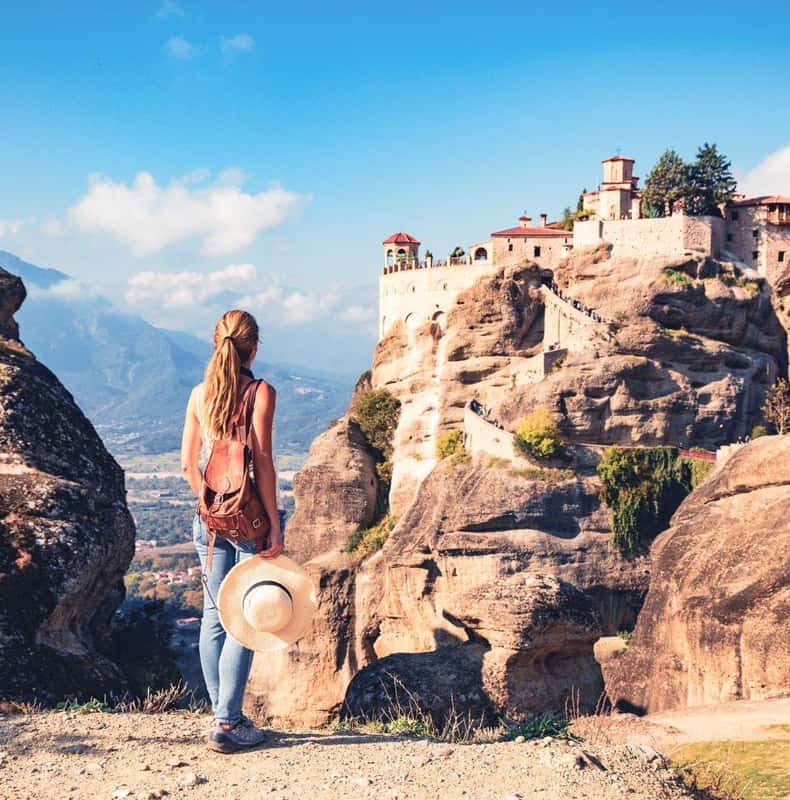
Roussanou is the monastery that appears to grow directly out of the rock rather than sitting on top of it. Built in 1545 on a narrow vertical pillar at lower elevation than most of the others, it is reached by a bridge rather than a long staircase, making it one of the more accessible monasteries as well as the most photographed from the exterior. It is a nunnery, home to a small community of nuns who also produce an award-winning oak honey sold in the monastery shop.
The approach to Roussanou is unlike any of the other five monasteries. Rather than a long staircase cut into the rock face, you walk across a stone bridge over a narrow gorge, then through an arched entrance directly into the monastery complex. The transition from outside to inside is immediate. One moment you are on the road, the next you are in the courtyard. This accessibility is one reason Roussanou tends to feel more intimate than the larger monasteries: there is no long climb to separate the tourist bustle below from the quiet above.
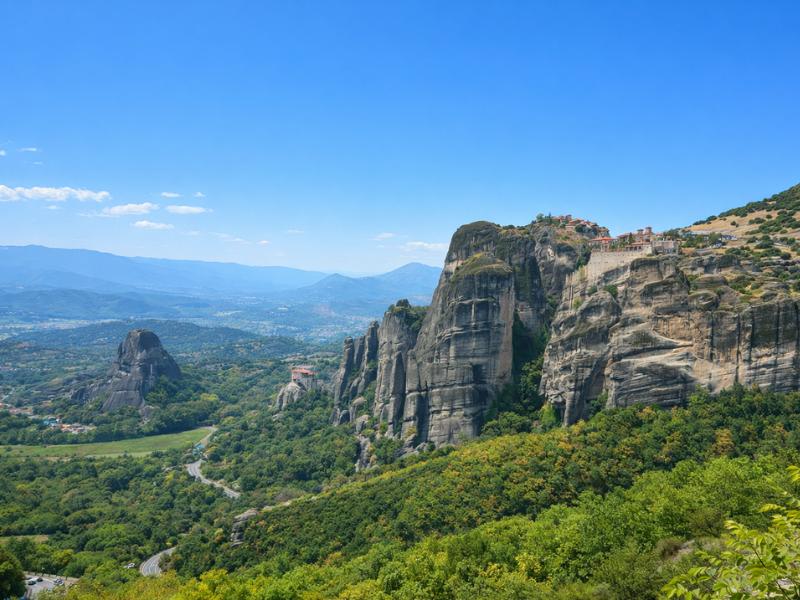
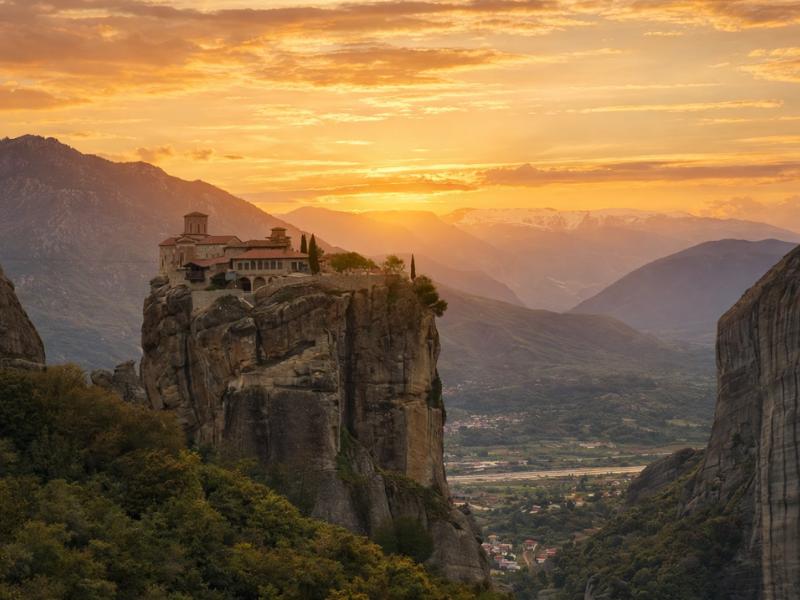
The exterior view is what draws most people to Roussanou specifically. From the road between St. Nicholas Anapafsas and Varlaam, the monastery appears as a stone box balanced on a finger of rock, its walls flush with the sheer vertical face below. It looks less like a building placed on a rock and more like something that grew there. The best exterior view is from the small platform below the Psaropetra lookout, where you can see Roussanou in the foreground with Varlaam and Grand Meteoron behind and above it – all three in a single frame.
Inside, the frescoes are among the most vividly preserved at Meteora. The original church was built in 1545 and frescoed in 1552. The paintings represent scenes of martyrdom in considerable detail – Roussanou’s frescoes are not subtle about the suffering of saints, but the colors remain rich and the execution is striking. The courtyard is immaculately kept, with flower pots on every available ledge and a sense of domestic care that reflects the nuns’ long presence here. The community moved in permanently in 1988, ending a period when the monastery operated with minimal or no permanent residents.
The honey shop near the entrance sells the nuns’ oak honey in small jars. Oak honey is produced from the secretions of a scale insect that feeds on oak trees rather than flower nectar, giving it a darker color and more complex flavor than standard honey. The Roussanou variety has been recognized at regional and European levels. It is worth buying before you leave even if honey isn’t normally something you seek out, because the provenance is genuinely unusual and the nuns produce a limited quantity each year.
The photos are everywhere, but does it live up to them? Here’s whether Meteora is worth visiting when you see it in person.
| Founded | 1545 by Maximos and Ioasaph of Ioannina; dedicated to Saint Barbara |
| Type | Nunnery (since 1988) |
| Access | Bridge, then moderate steps with handrails (~130 steps total) |
| Entry fee | €5 per adult, cash only |
| Summer hours | 10:00-16:00, closed Wednesday |
| Don’t miss | Exterior from Psaropetra lookout, frescoes (1552), oak honey shop |
| Best combined with | St. Nicholas Anapafsas (closest neighbor on the circuit) |
For the exterior composition described here, read the dedicated Psaropetra viewpoint guide before coordinating it with a Roussanou visit.
Holy Trinity (Agia Triada) – The Most Dramatic Setting
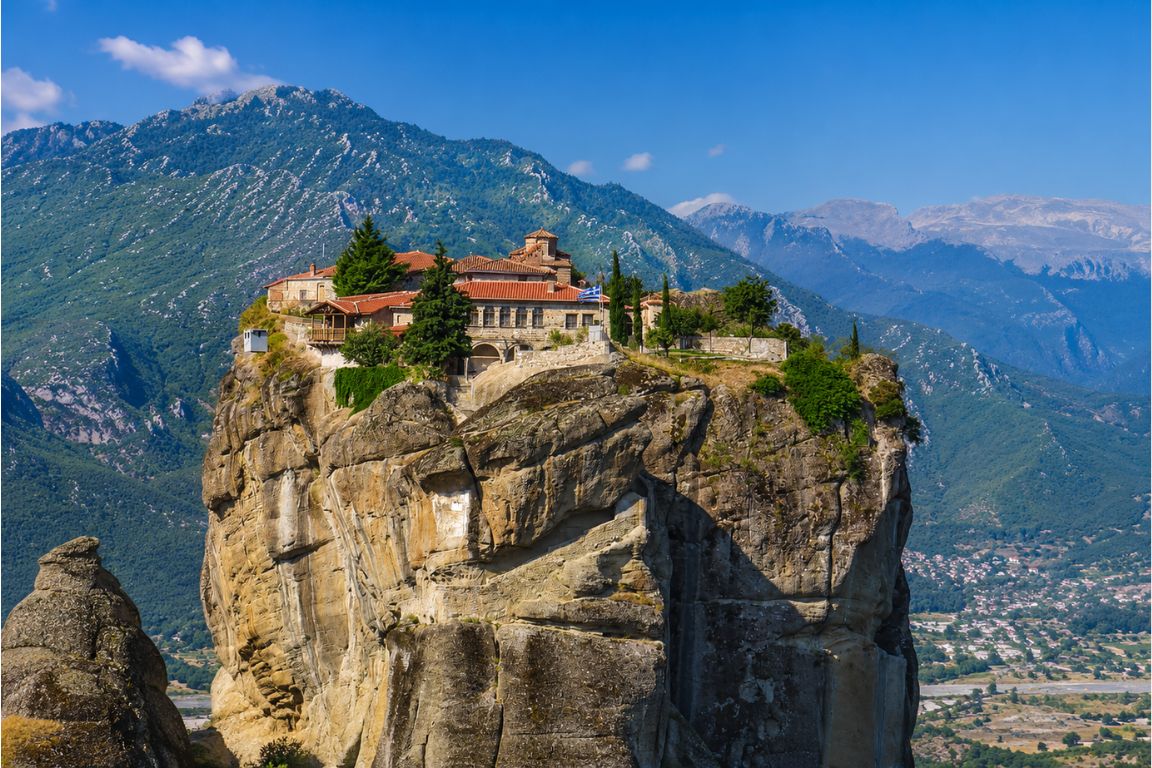
Holy Trinity sits on the most isolated pillar at Meteora, surrounded by open air on all sides, with a 360-degree view that covers the full extent of the valley and the other rock formations. The approach is the steepest climb of any of the six monasteries. It appeared in the 1981 James Bond film For Your Eyes Only, which is either irrelevant to your visit or the main reason you’re making it. Either way, the physical experience of standing in the courtyard with nothing but rock and air around you is genuinely unlike any of the other five.
The monastery was founded in 1458 and spent much of its history as one of the more remote and self-contained of the Meteora communities. Access before the 20th century was by rope ladder only. The current staircase cuts through the rock itself in a series of tunnels and exposed sections that alternate between claustrophobic and vertiginous in quick succession. The climb involves about 140 steps plus a walk on uneven rock paths before and after. It is the hardest approach of the six but not a technical challenge for anyone in reasonable condition.
The interior is smaller and simpler than Grand Meteoron or Varlaam. The main church frescoes are from the 16th century, painted by Karas Panagiotis, and depict the Virgin Mary, the Apostles, and scenes from the lives of saints. Holy Trinity was looted during the German occupation in World War II and again during the Greek Civil War, and much of its movable treasure was lost. What remains is the built fabric of the monastery, the frescoes, and the location. The location is enough.
The monks here are few – Holy Trinity is one of the more lightly staffed monasteries, and the visit has a quieter atmosphere than Grand Meteoron even when there are tour groups present, partly because the space is small enough that crowds disperse quickly and partly because there is no museum drawing people to a single room. Most visitors spend their time on the terraces, looking out over the valley and across to Varlaam and Grand Meteoron on the opposite ridge. Holy Trinity’s position makes it the best place to understand the spatial relationship between all the rock formations.
A drinking fountain at the entrance is worth noting specifically, because Holy Trinity’s climb in summer heat is the kind of thing that makes you wish you had carried more water than you did.
| Founded | 1458 |
| Steps | ~140 steps plus rock paths (steepest approach of the six) |
| Entry fee | €5 per adult, cash only |
| Summer hours | 10:00-17:00, closed Thursday |
| Winter hours | 10:00-16:00, closed Thursday |
| Don’t miss | 360° terrace views, the tunnel sections of the climb, the James Bond filming location |
| Note | Holy Trinity closes for prayers ~13:00 for 15 min. If the gate looks locked at lunchtime, wait a few minutes. |
Compare Holy Trinity’s steep approach with the lower-stair option described for St. Stephen’s before deciding which route suits your party.
St. Stephen’s (Agios Stefanos) – The Most Accessible
Before settling on St. Stephen’s for a family visit, plan the breaks, timing and practical needs around the monastery stop.
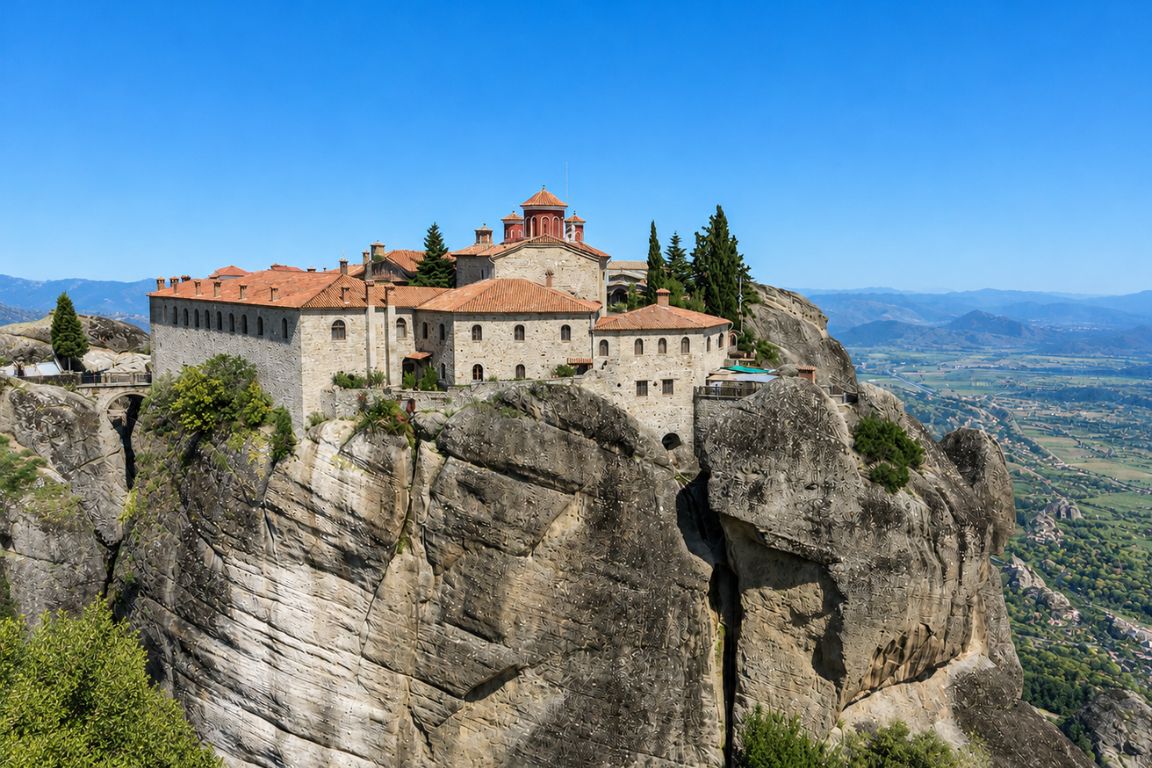
St. Stephen’s is the only monastery at Meteora with no staircase. You walk across a bridge from the car park and you are inside. For travelers with mobility issues, families with young children, or anyone who has already climbed 300 steps at Grand Meteoron and isn’t sure they have another flight in them, St. Stephen’s is the practical answer. It is a nunnery with a strong Byzantine history, two distinct churches, a carved wooden iconostasis from 1814, and some of the best views toward Kalambaka and the plain.
The monastery has the oldest documented history of any at Meteora, with accounts placing the first hermit presence here in the 12th century, predating Saint Athanasios and Grand Meteoron by nearly two hundred years. Byzantine imperial connections run through its history: the monastery received imperial grants and was reportedly visited by Byzantine royalty in the 14th and 15th centuries, which explains the quality of some of its early decorative work. Most of what visitors see today dates from the 16th century rebuild and subsequent periods of restoration.
There are two churches inside. The older one, dedicated to Saint Stephen, preserves 16th-century frescoes in relatively good condition. The newer one, the Church of Saint Charalampios built in 1798, is the more visually impressive: its carved wooden iconostasis from 1814 is one of the finest pieces of ecclesiastical woodcarving at Meteora, the kind of work that rewards looking closely rather than photographing and moving on. Saint Charalampios is a significant figure in Orthodox tradition – patron saint against plague, and his relics are housed here, which makes St. Stephen’s a genuine place of pilgrimage as well as a tourist destination.
St. Stephen’s sits at the eastern end of the monastery circuit, overlooking Kalambaka directly below. From the terrace, the town, the train station, the plain of Thessaly, and the distant mountains behind Trikala are all visible in a way that reminds you exactly where in Greece you are. It is a geographically clarifying view. The monastery museum holds a collection of Byzantine icons, ecclesiastical vestments, and carved wooden liturgical objects.
We’ve got a full breakdown on visiting Meteora tours with kids if you want to know exactly which monasteries work for families and how to structure the day without meltdowns.
| Founded | 12th century (earliest documented monastery at Meteora) |
| Type | Nunnery |
| Access | Flat bridge – no stairs required |
| Entry fee | €5 per adult, cash only |
| Summer hours | 09:00-13:30, 15:30-17:30, closed Monday |
| Don’t miss | Carved wooden iconostasis (1814), views over Kalambaka, relics of Saint Charalampios |
| Best for | Mobility-limited visitors, families, travelers combining it with a Kalambaka afternoon |
St. Nicholas Anapafsas – The Most Underrated
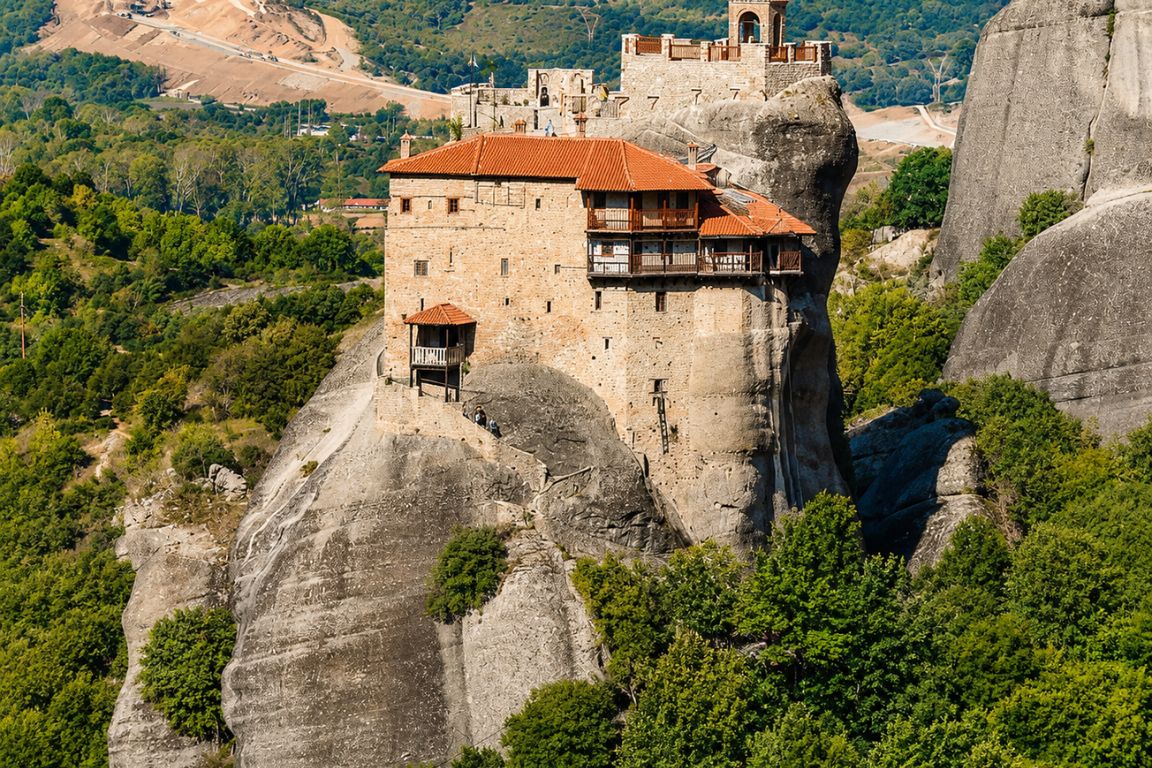
St. Nicholas Anapafsas contains the most significant frescoes at Meteora from an art-historical perspective. Painted in 1527 by Theophanes the Cretan – a post-Byzantine master who was the teacher of El Greco – the paintings in the katholikon are remarkable in their technical quality and are among the most important works of their period surviving anywhere in Greece. The monastery is the smallest and quietest of the six, and because most visitors are drawn directly to Grand Meteoron and Varlaam, you can often have the frescoes almost entirely to yourself.
The monastery is the first one you see driving up from Kastraki, sitting on a narrow vertical rock at lower elevation than the others. Because the rock surface at the top was limited, the builders stacked the monastery vertically rather than spreading it horizontally: the different levels of the building – chapel, cells, refectory, prior’s quarters – are arranged one above the other like floors of a small tower. This compression gives it a distinctive atmosphere, intimate rather than grand, that feels nothing like the spacious courtyard of Grand Meteoron.
Theophanes the Cretan worked at Meteora in 1527 during a period before he went on to paint at Mount Athos and other major Orthodox sites. His connection to El Greco is historically documented: Domenikos Theotokopoulos, who became El Greco, trained in the Cretan workshop tradition that Theophanes represented. Standing in the low chapel at St. Nicholas and looking at the ceiling frescoes, you are looking at work from the same lineage that produced some of the most famous paintings in Western art. This is either the most interesting piece of art context at Meteora or a piece of trivia, depending on your disposition.
The monastery was completely abandoned for about 60 years from 1900 to the 1960s, when the Greek government funded restoration. The intervention saved the frescoes, which were deteriorating. The current state of preservation is good, with the main images still vivid in their original colors. The monastery has a single resident monk – at times just one, making it perhaps the most lightly inhabited active monastery in Greece.
St. Nicholas is open daily in summer, one of only two monasteries without a weekday closure in peak season. It is closed on Fridays in winter. The climb is around 100 steps, shorter than any of the other staircase monasteries. This combination – quiet, open daily, shorter climb, most significant art – makes it an excellent addition to any full-day visit even if it isn’t a priority on most tour itineraries.
| Founded | Late 14th century |
| Key artist | Theophanes the Cretan (frescoes 1527); teacher of El Greco |
| Steps | ~100 (shortest climb of the staircase monasteries) |
| Entry fee | €5 per adult, cash only |
| Summer hours | 09:00-17:00, open daily |
| Winter hours | 09:00-16:00, closed Friday |
| Don’t miss | Theophanes frescoes in the katholikon (1527), the vertical architectural layout |
| Best for | Art lovers, crowd-avoiders, anyone wanting a second monastery on a Friday |
Check your date before arranging separate rides around the monastery circuit. The morning minibus combines local pickup with time inside three monasteries.
How to Plan Your Monastery Visit Around Opening Days
The single most common planning mistake at Meteora is arriving on the wrong day for the monastery you most want to see. Grand Meteoron closes Tuesdays. Varlaam closes Fridays. Holy Trinity closes Thursdays. Roussanou closes Wednesdays. St. Stephen’s closes Mondays. St. Nicholas Anapafsas is open daily in summer. All six open Saturdays and Sundays. Saturday is the easiest day to plan because all six are available; the trade-off is that weekends are also the busiest days.
The practical way to approach the planning: decide which two or three monasteries matter most to you, then find the day when all of them are open. Grand Meteoron and Varlaam together require a day that is neither Tuesday nor Friday. That gives you Monday, Wednesday, Thursday, Saturday, Sunday – five options. Grand Meteoron, Varlaam, and Roussanou together require avoiding Tuesday, Friday, and Wednesday – leaving Monday, Thursday, Saturday, Sunday. The more monasteries you add, the fewer days work.
Friday is the most restrictive weekday. Both Varlaam and St. Nicholas Anapafsas are closed on Fridays, leaving only four of the six monasteries available. If your trip to Meteora falls on a Friday, prioritize Grand Meteoron, Roussanou, Holy Trinity, and St. Stephen’s and leave the other two for a second day if you have one.
| Monday | Grand Meteoron, Varlaam, Roussanou, Holy Trinity, St. Nicholas | St. Stephen’s | Good day for the four main monasteries |
| Tuesday | Varlaam, Roussanou, Holy Trinity, St. Nicholas, St. Stephen’s | Grand Meteoron | Avoid if Grand Meteoron is a priority |
| Wednesday | Grand Meteoron, Varlaam, Holy Trinity, St. Nicholas, St. Stephen’s | Roussanou | Best weekday for Grand Meteoron + Varlaam combo |
| Thursday | Grand Meteoron, Varlaam, Roussanou, St. Nicholas, St. Stephen’s | Holy Trinity | Good for Roussanou + Varlaam + Grand Meteoron |
| Friday | Grand Meteoron, Roussanou, Holy Trinity, St. Stephen’s | Varlaam, St. Nicholas | Fewest options – the weakest weekday |
| Saturday | All six | None | Busiest day – arrive before 09:30 |
| Sunday | All six | None | Busier due to Greek worshippers; still manageable early |
Beyond weekly closures, the Orthodox calendar adds feast days when individual monasteries close to tourists for religious services. Each monastery closes on the feast day of its patron saint, and on major Orthodox holidays like Holy Week, several close for parts of the week. These dates shift every year with the Orthodox calendar and are not published far in advance. The most reliable way to check is the notice board at the monastery entrance. If you arrive at a monastery and find an unexpected closure sign, check the board for the reopening time before deciding whether to wait or continue to the next site.
The practical note on timing: be at the first monastery by 09:30. This applies year-round. In summer, the Athens day-tour coaches arrive between 10:30 and 11:00 and the crowd volume changes noticeably. In winter, the short afternoon closing hours (15:00 in some cases) mean you have less margin for late starts. The monasteries that work best as a first visit in the morning sequence are Grand Meteoron and Varlaam in the west, and St. Nicholas Anapafsas in the east from Kastraki.
Thinking about adding Meteora to your Greece itinerary? Here’s how to visit Meteora tours so you don’t end up at a closed monastery gate.
Explore a four-hour route that joins three monastery visits and panoramic stops, with transport between the formations handled for you.
How Our Guests Rate the Monasteries: Patterns from 14,400+ Guided Visits
| Most requested monastery (all travelers) | Grand Meteoron (~94% of guided groups) |
| Highest post-visit satisfaction score | Varlaam (interior experience) and Holy Trinity (setting) |
| Most cited “unexpected highlight” | St. Nicholas Anapafsas (~38% of travelers who visited) |
| Most purchased souvenir | Roussanou oak honey |
| Most common regret | “Didn’t allow enough time inside Varlaam” (~29% of half-day visitors) |
| Travelers who visited all six | ~22% (mostly two-day visitors) |
Set aside aggregate guest patterns and compare all six monasteries by your own interests, available time, and tolerance for steps.
Frequently Asked Questions
Use the broader planning guide to compare monastery priorities and visit order before working through the individual questions below.
Which Meteora monastery should I visit if I only have time for one?
Grand Meteoron. It is the oldest, the largest, and the highest, with the best museum, the most complete interior experience, and the most historically significant frescoes. Combine it with Varlaam if you have any flexibility at all – they are five minutes apart and together cover the two most rewarding monastery interiors at Meteora.
Check the morning tour for your date before planning additional stops. Its four-hour route gives you time inside three monasteries, with local pickup and return.
Which monastery at Meteora is easiest to access?
St. Stephen’s (Agios Stefanos) is the only monastery with no staircase. You walk across a flat bridge from the car park directly to the entrance. It is the best choice for travelers with mobility issues, older visitors, or families with very young children. It is closed on Mondays.
Use the St. Stephen’s overview to understand the bridge approach and other visitor considerations before making an individual access decision.
Are the Meteora monasteries still active?
Yes. All six are working monasteries with resident monks or nuns. Grand Meteoron, Varlaam, Holy Trinity, and St. Nicholas Anapafsas are male monasteries; Roussanou and St. Stephen’s are nunneries. Approximately 17 monks and 50 nuns live across the six sites. Religious services take place regularly, and some areas are restricted to worshippers during services.
Prepare for entry to an active religious community by reviewing photography restrictions, conduct, and other monastery etiquette.
How much does it cost to enter the Meteora monasteries?
€5 per adult per monastery, paid in cash at the entrance. Children under 12 enter free. Greek nationals may enter free on some dates. There is no combined ticket. If you visit all six, the total entrance cost is €30 per adult.
Enter your planned admissions, transport, and other trip expenses to compare complete visitor totals rather than considering monastery entry alone.
Which monastery has the best frescoes?
Varlaam has the best overall fresco program – the work of Frangos Katelanos from 1548 covers the full interior and is exceptionally well preserved. St. Nicholas Anapafsas has the most art-historically significant frescoes: the 1527 works of Theophanes the Cretan, teacher of El Greco. If interior painting is your primary interest, visit both.
Discover a route with time inside three monasteries as well as photo stops outside. Local minibus travel connects the visits so you can spend that time exploring.
Can I visit all six Meteora monasteries in one day?
Technically yes in summer, when each monastery takes 30-45 minutes and the drive between them is short. In practice, most experienced visitors recommend two or three for a satisfying experience rather than rushing all six. By the fourth monastery, the interiors and courtyards begin to blur. Spreading across two days – or doing a thoughtful four in one full day – is generally more rewarding.
Check the two-day Athens departure before arranging a separate hotel and return journey. It combines a sunset outing with a second guided morning, with hotel options available.
Not sure which monasteries to prioritize for your specific dates?
The closure day matrix changes the answer based on when you arrive. The full-day tour from Athens includes an expert local guide and a Greek meal, on dates you can check before you travel.
Written by Michael Angelos
Greek tour guide since 2009 · Founder, Meteora Tours
Michael has guided over 14,400 travelers through the monasteries and rock formations of Meteora since founding the agency.