Best Meteora Sunset Spots
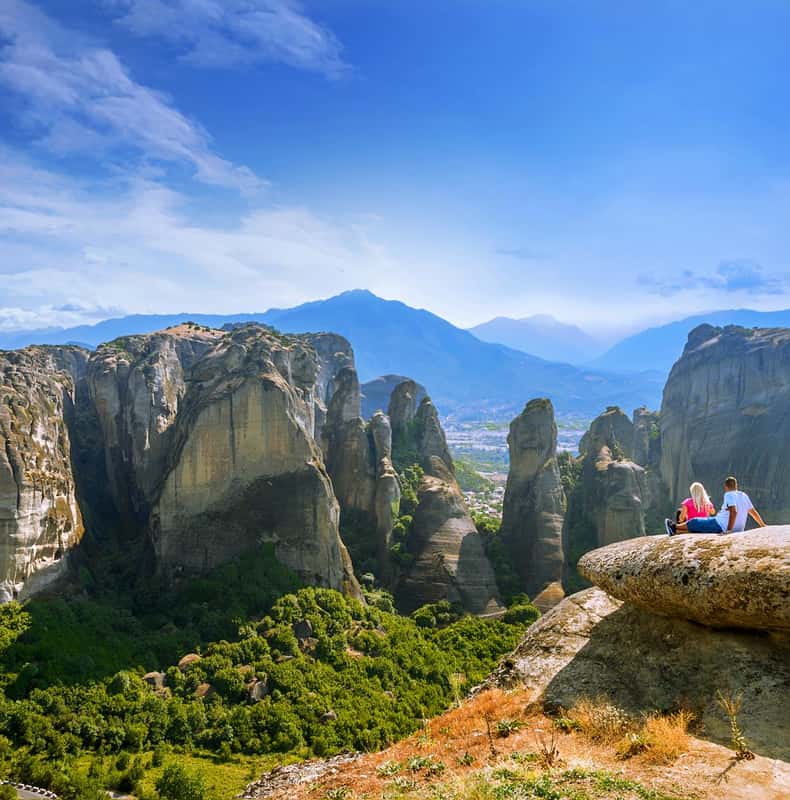
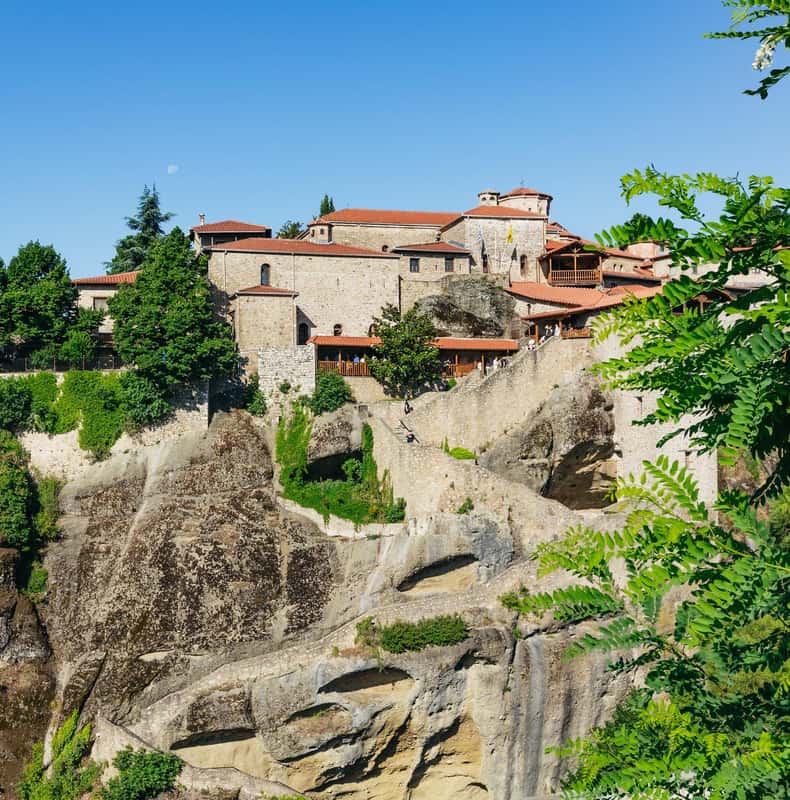
The best Meteora viewpoints include Sunset Rock, hidden panoramic lookouts, and monastery terraces - perfect for unforgettable sunrise and sunset photos.
Sunset Rock gives the classic composition, while the unsigned saddle offers a quieter panorama. Choose a local evening route for coordinated transport, or stay overnight when returning to Athens would mean missing sunset. Choose A Tour For This Itinerary
Last updated: June 28, 2026
Why Is Meteora Sunset So Special?
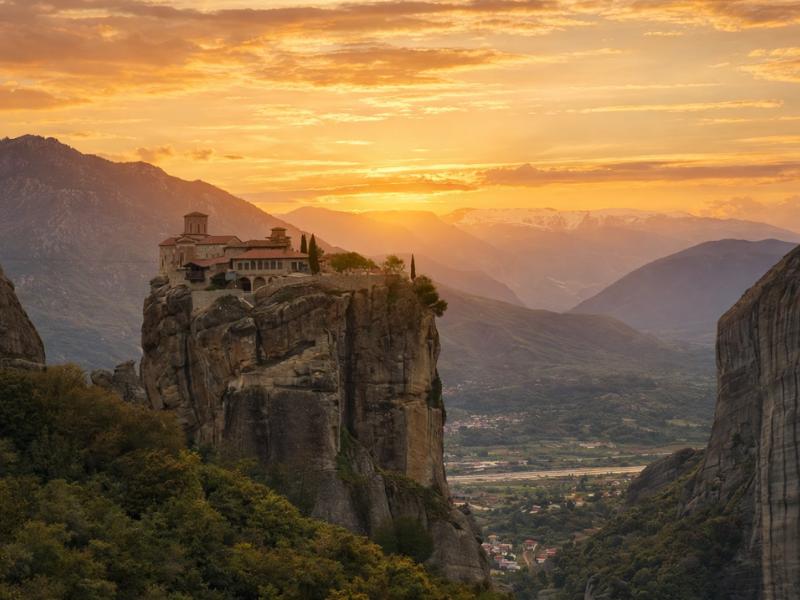
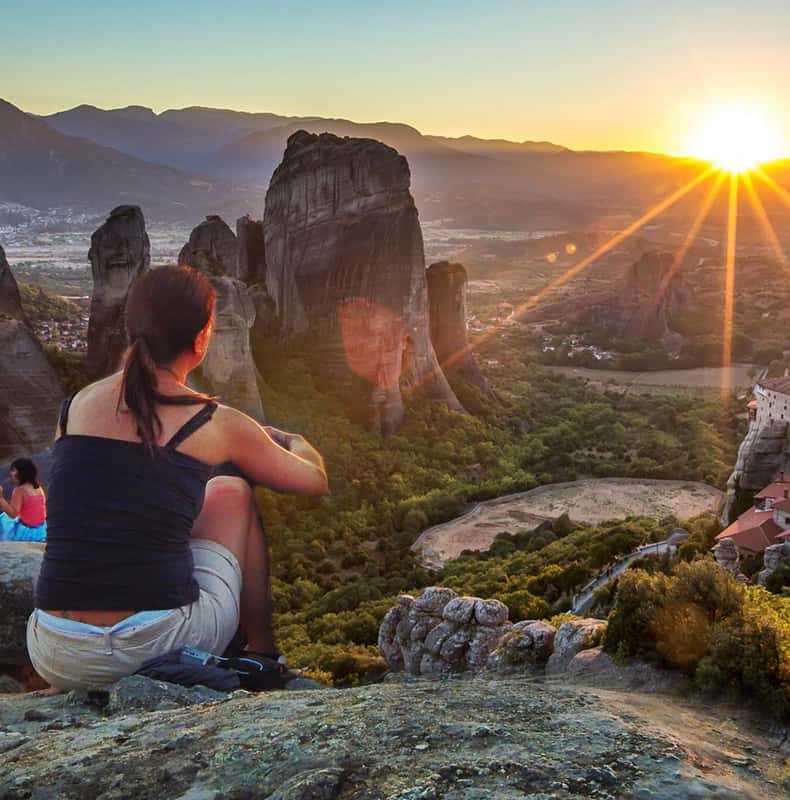
The sandstone and conglomerate that forms the Meteora pillars contains iron minerals that respond to low-angle light in a way that changes the entire color of the site. At midday the rocks are pale grey. In the hour before sunset they shift through amber, rose, and deep copper, and the monasteries perched on top of them seem to glow from within. No filter, no processing. This is just what the rock does when the sun drops toward the Pindus mountains to the west, and it lasts roughly 20 to 30 minutes before it is gone.
Most popular sites look their best at sunset. Meteora is different from most because the scale of the transformation is so extreme. A visitor who arrives at midday on a bright summer day and sees the pillars in flat white glare would not recognize the same landscape an hour before dark. The contrast is not subtle. The rock color shifts visibly over the course of minutes. Photographers who have shot landscapes across Europe consistently cite Meteora as one of the most technically rewarding sunset locations on the continent, and the reason is specific: the angular geometry of the pillars means that at low sun angles, some faces catch full light while others fall into deep shadow, producing a three-dimensional quality that flat coastal or plain landscapes cannot match.
The other factor is the monastery silhouettes. The buildings on top of the pillars turn into dark shapes against the lit sky and the glowing rock below them at the same moment the rock itself is warmest. The combination of organic geology and man-made architecture in a single frame, both transformed by the same light, is what makes the Meteora sunset images look the way they do.
Being there for sunset requires staying overnight or at least arriving in the early afternoon. Day-trippers who leave at 16:00 never see it. In our experience guiding travelers here for seventeen years, the sunset is consistently cited as the single most memorable moment of any Meteora visit, ahead of the monasteries themselves. Our sunset tours from Meteora Tours depart in the late afternoon and end at the viewpoints as the last light fades.
Still on the fence? Here’s an honest look at whether Meteora is worth visiting for different types of travelers.
Discover an evening route that combines monastery visits, hermit caves and sunset viewpoints, with pickup from Kalambaka or Kastraki.
Sunset Rock (Psaropetra) – The Most Famous Viewpoint
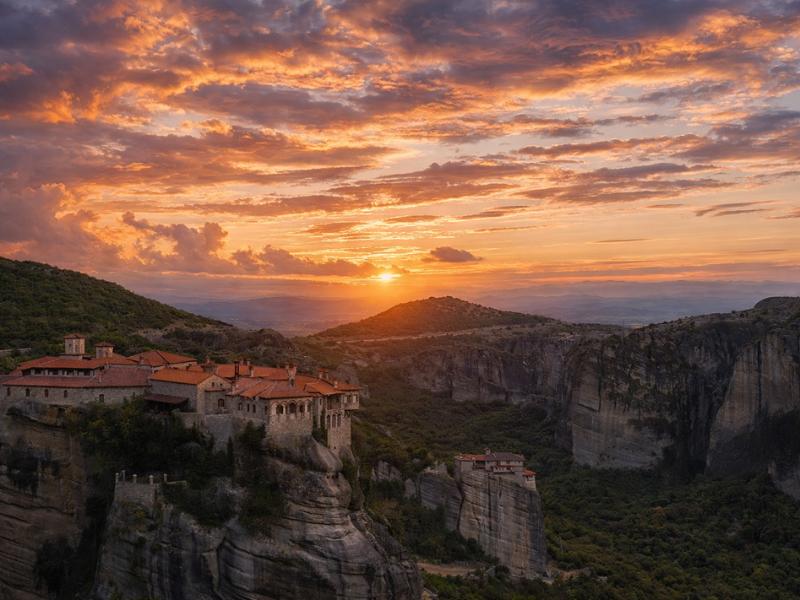
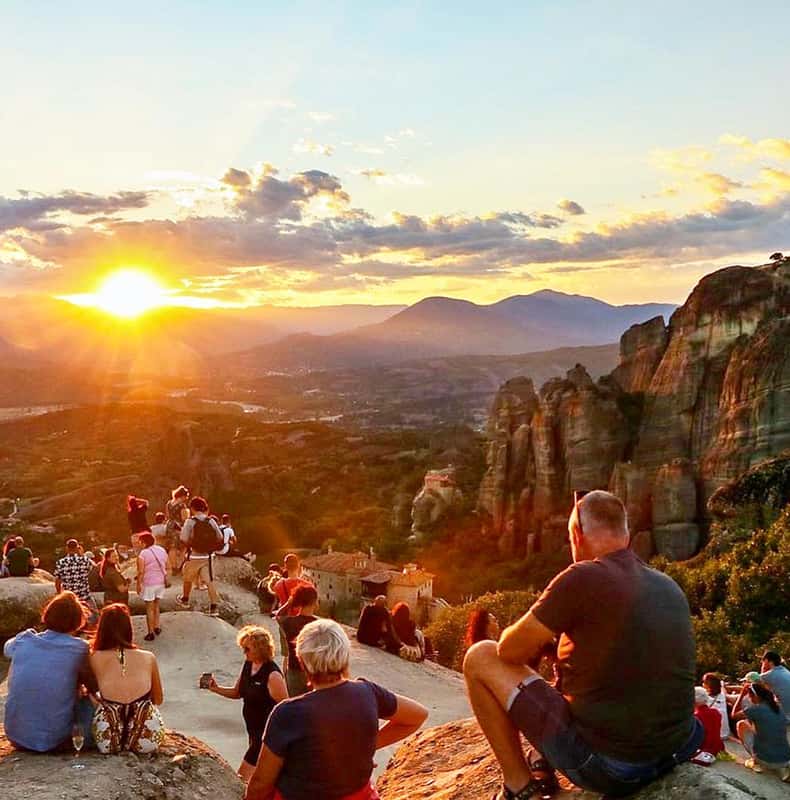
Sunset Rock, officially the Psaropetra lookout, is a flat-topped boulder on the monastery circuit road where you can see Roussanou Monastery directly below and three additional monasteries stretching back along the ridge. It is the most photographed single viewpoint at Meteora and the one most sunset tours include as their final stop. It fills quickly in summer. Arrive at least 30 to 40 minutes before sunset to claim a spot on the rock surface.
The location sits on the main monastery circuit road, roughly between the Roussanou junction and the fork toward Varlaam. A small gravel shoulder on the roadside serves as parking. The rock itself requires a short scramble of about two or three meters up an angled boulder face, nothing technical but involving some stepping with both hands. Once on top, the surface is wide enough for a group of people with room to move around. There are no railings. The edge on the valley side drops away without barrier, so stay aware of where you are standing, particularly in the dark after sunset.
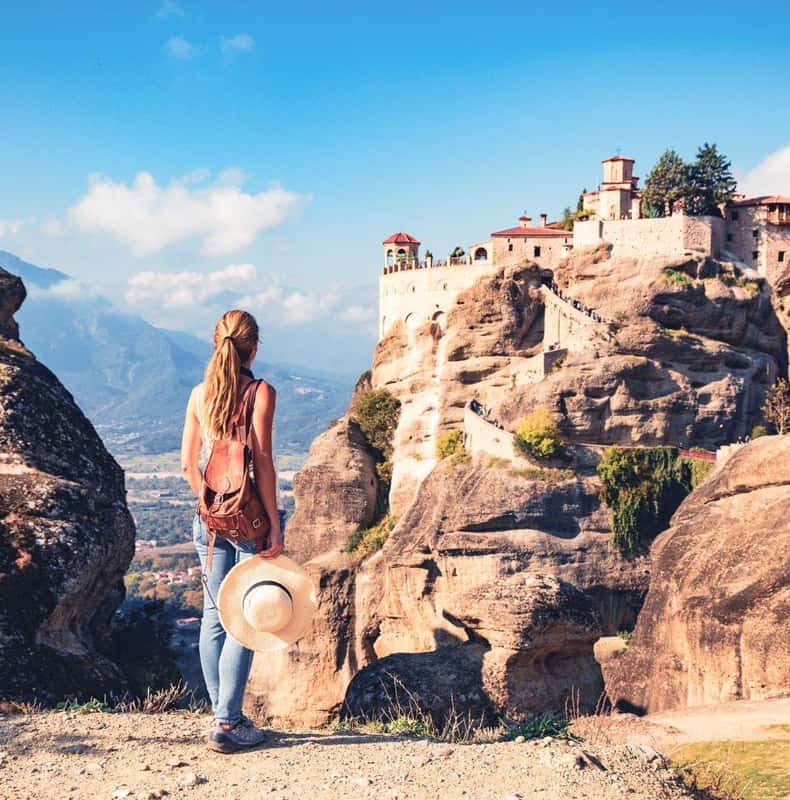
From the top, looking roughly south and southwest, Roussanou Monastery fills the near foreground, its walls appearing to grow directly from the narrow rock below it. Varlaam is visible further back and higher up on the left. Grand Meteoron appears as a broader mass on the ridge above Varlaam. St. Nicholas Anapafsas is visible lower and to the right. Four monasteries in a single frame, arranged at different distances and elevations, all turning amber as the sun drops. This is the shot that appears in essentially every professional photo series about Meteora.
The crowd at this spot in July and August can be 50 to 100 people at peak time. This is not the quiet contemplative experience some travelers expect. It is a shared spectacle, and it is still worth it. The light does not care about the crowd. A more private alternative for the same general direction of view is the small pull-off on the roadside just below Sunset Rock, where you can photograph Roussanou at eye level with fewer people around.
Check your date before arranging the rest of your afternoon. This four-hour guided route includes local pickup and return, with viewpoint stops along the way.
The 180-Degree Saddle Viewpoint – The One Most Travelers Miss
Explore an evening of monastery scenery, hermit-cave history and panoramic stops. A local guide and minibus connect the experience beyond a single roadside viewpoint.
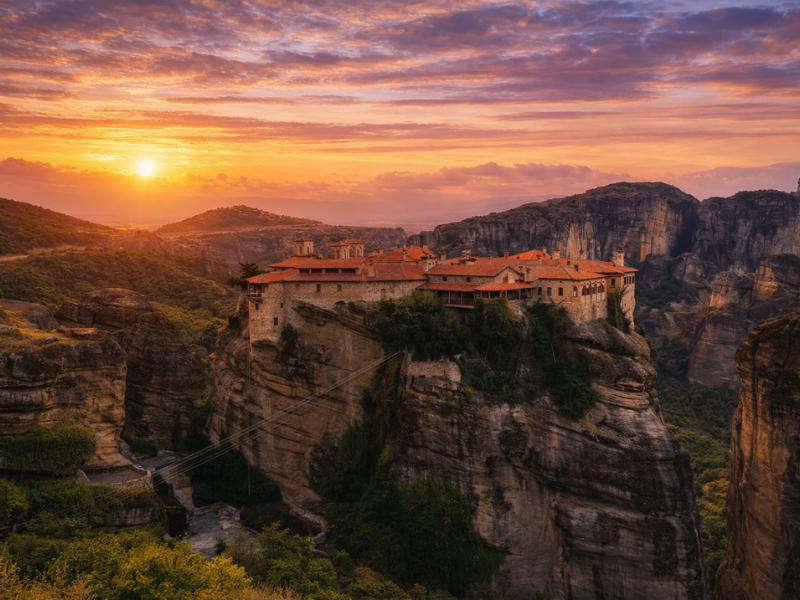
Roughly 1.2 km back down the monastery road from the Grand Meteoron car park, just after a sharp right-hand bend, a small gravel shoulder on the right side of the road marks one of the best viewpoints at Meteora. From that pull-off, looking south, you can see five of the six active monasteries simultaneously. There is no sign. Most visitors drive past it. Guided sunset tours that know the road stop here regularly.
Finding this spot independently requires knowing what to look for. Drive down from the Grand Meteoron car park toward Roussanou. The road descends through several bends. After the sharpest right-hand bend, where the road briefly straightens before the next curve, look for a small gravel area on the right where two or three cars can pull off. From there, walk a few meters to the southern edge of the road and look out over the valley. The view that opens is why professional photographers keep returning to Meteora.
The five monasteries visible from this point are Grand Meteoron, Varlaam, Roussanou, St. Nicholas Anapafsas, and Holy Trinity. Each sits on a different rock at a different elevation and distance, creating a sense of depth that no single monastery viewpoint can match. At sunset this view has the additional benefit of a slightly elevated angle over Roussanou, which means you see the monastery from above rather than at eye level as you do from Sunset Rock. The composition possibilities are wider here and the spot is almost always quieter.
This is not a formally designated viewpoint, which is exactly why it matters. The monastery road was built to connect the sites, not to optimize photography. The best view of the whole complex happens to be from a random bend in the road where the saddle between two rock masses creates an accidental 180-degree sightline. Knowing where it is before you arrive saves the frustrated slow-driving-and-squinting that most first-time visitors do while trying to find it.
We’ve got a full breakdown on which Meteora monasteries are best to visit if you want to know exactly which ones are worth the climb and which you can skip.
The North Face Varlaam Viewpoint
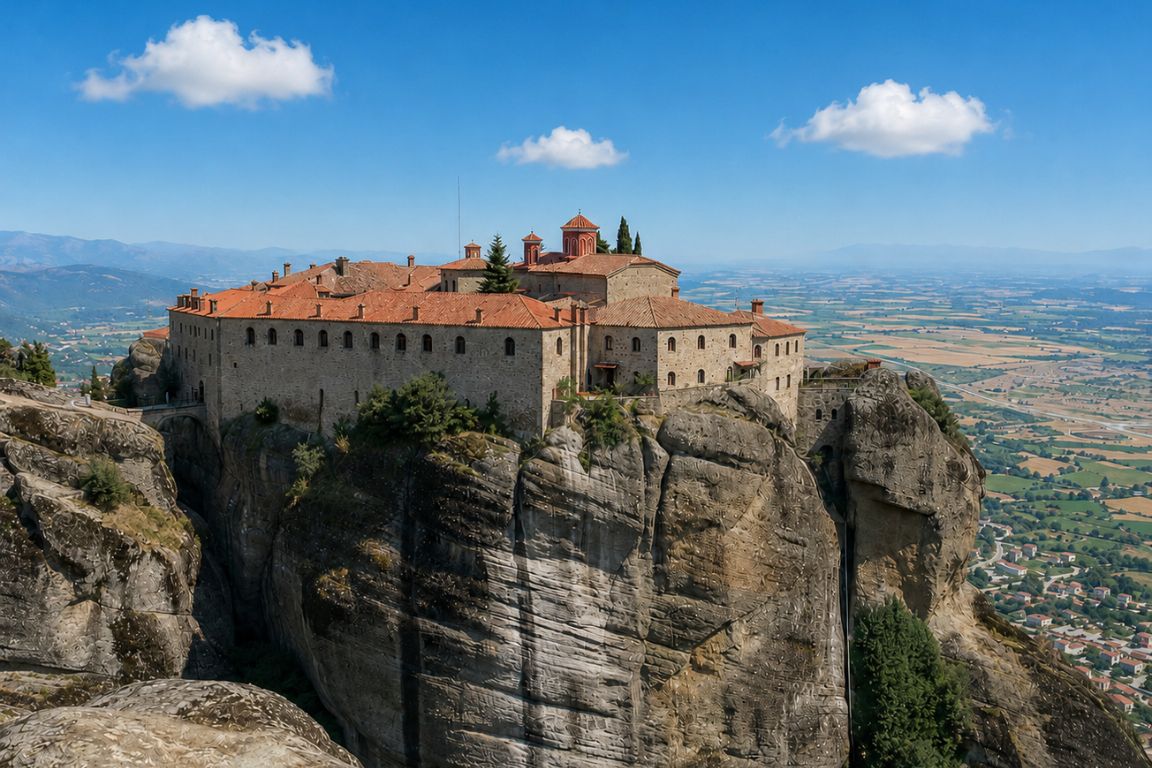 From the Grand Meteoron parking lot, walking back down the road and looking for a set of stone steps on the right leading up to large boulders, you reach an elevated position that shows Varlaam from an angle almost no tourist photograph captures. The monastery’s northern face, the winch tower side, appears in the foreground. Roussanou is visible at distance behind it. The view works for both sunset and sunrise depending on the season and is consistently quieter than Sunset Rock.
Most Varlaam photographs are taken from the south and west, which is where the monastery road runs. This viewpoint shows the opposite face, the one where the historic winch tower projects from the rock wall and the original rope basket mechanism is visible from below. In the late afternoon, low light catches this side of the formation when the more famous southern viewpoints are still in shadow or directly facing the sun. The angle is different and the composition is different, which is why photographers who have already shot Meteora from every standard position come back to find this one.
The steps leading up from the road are made of rough stone and blend into the hillside. They are not signposted. From the parking lot, walk back down the road for about 100 meters and look right. The steps begin just above road level and lead up through a gap in the rock to the boulder platform. The platform is large enough for several people with space between them and the view is unobstructed to the north and northwest. Kastraki village is visible in the valley below to the left.
This viewpoint makes a practical addition to any Grand Meteoron visit. After finishing inside the monastery, walk back down and spend 20 minutes here before driving on to the next site. The light in the hour before closing time at Grand Meteoron often produces better conditions from this spot than full midday sun from Sunset Rock.
If the rough steps and boulder platform do not suit your visit, the Kastraki section describes a village-level sunset alternative beneath the rock formations.
Holy Trinity Terrace – Sunset from Inside a Monastery
Check your date before combining monastery visits with a separate sunset outing. This local route brings both into one afternoon and evening plan.
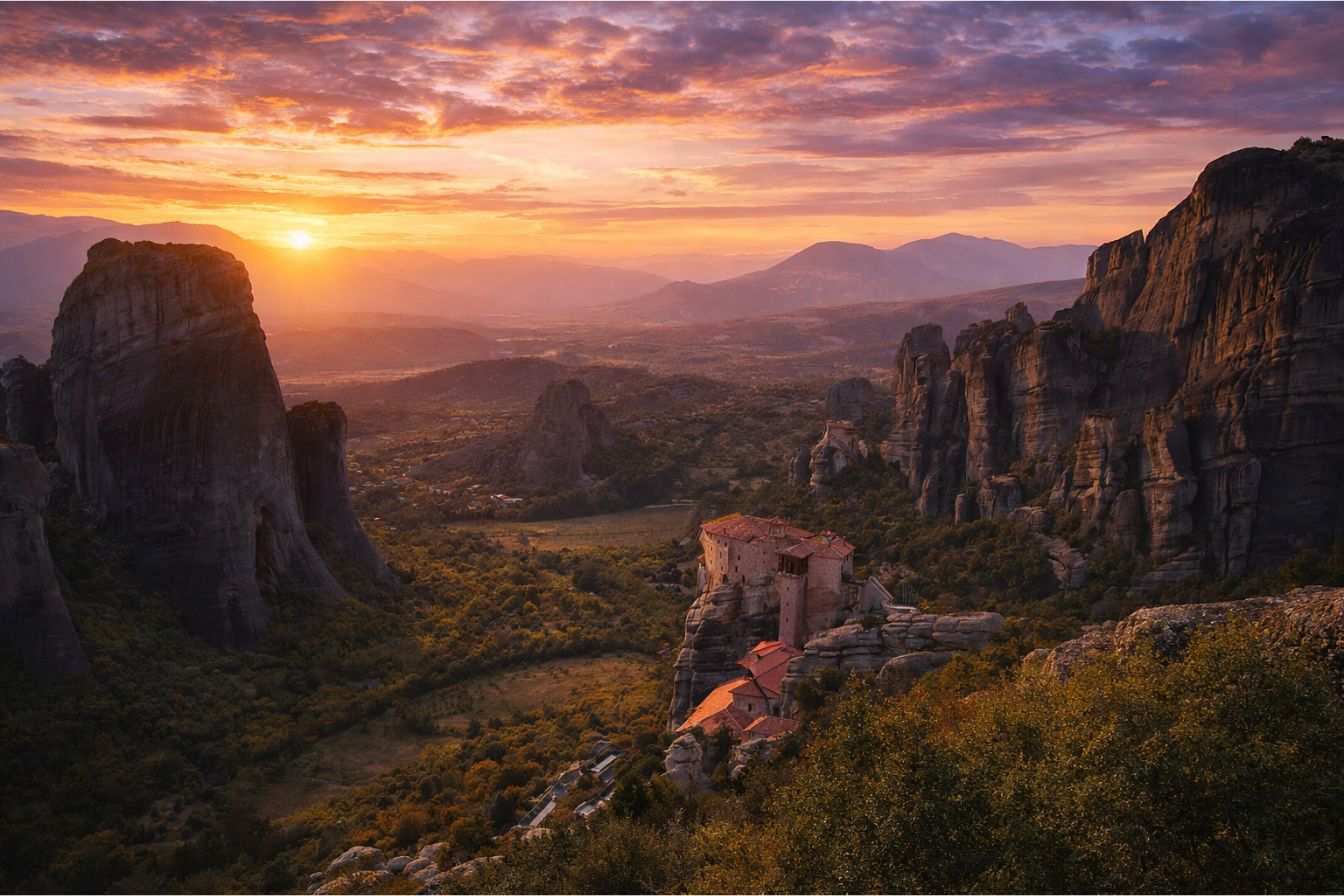 Holy Trinity is the only one of the six monasteries where the closing time in summer extends late enough to watch sunset from inside. The monastery closes Thursdays and shuts at 17:00 in summer, which in the long days of June and July still means the terraces are open an hour or more before the sun goes down. The 360-degree view from Holy Trinity’s position on its isolated pillar makes it the most complete sunset panorama available from any location at Meteora.
Holy Trinity sits on the most isolated pillar in the complex, with open air on every side and nothing between the terrace and the horizon in any direction. From the south-facing terrace you look out toward Kalambaka and the Thessalian plain, which in the late afternoon catches the same warm light as the rock formations but spreads it across a much greater distance. From the north-facing side you can see Roussanou, Varlaam, and Grand Meteoron on their ridge, the whole western cluster of monasteries visible together. This is the view that makes you understand the spatial relationship between the formations in a way that looking from one single viewpoint on the road does not.
The practical detail that matters: Holy Trinity closes at 17:00 in summer. Greece is on Eastern European Time, and daylight saving means summer sunsets are at 20:00 or later. So being inside Holy Trinity at closing time in July does not give you a sunset from the terrace. What it gives you is good afternoon light and a clear view. For the actual sunset from this position, the terrace outside the entrance gate is still accessible after closing. A small path below the closed gate leads to a rock ledge on the eastern face where you can sit and watch the sun go down over the western cluster of monasteries without being inside the monastery itself. The view from this ledge is arguably better than anything inside the walls.
The climb to Holy Trinity is the steepest of the six monasteries, involving about 140 steps plus rock paths. Do it in the afternoon when temperatures are dropping rather than at midday. Holy Trinity closes Thursdays.
Kastraki Village – Sunset Without Climbing Anything
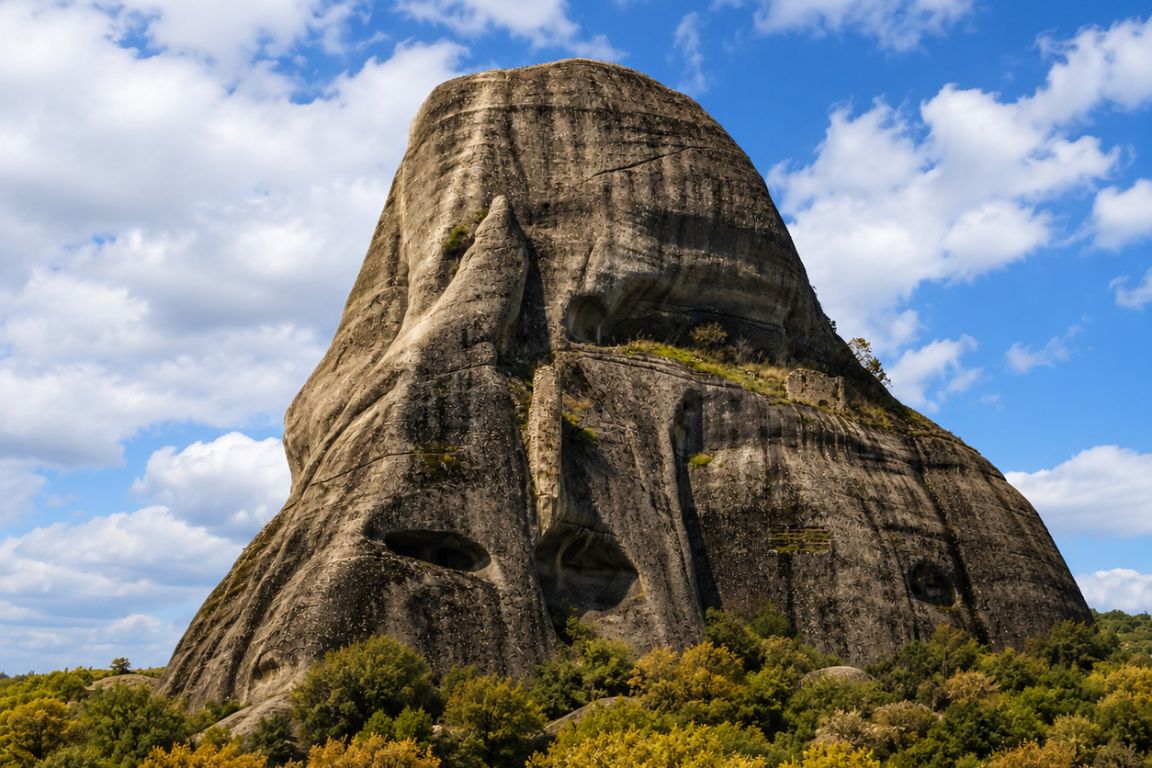 Kastraki village sits directly under the southern rock formations and the pillars are visible from almost every street. For travelers who cannot manage the scramble up to Sunset Rock or who simply want to watch the light change from a taverna chair rather than a boulder edge, Kastraki is the answer. The rock faces above the village catch the last direct light of the day while the village itself is already in the shade of the eastern formations, creating a reverse silhouette effect where the inhabited valley is dark and the ancient rock is bright.
The Doupiani rock at the edge of the village is the obvious focal point. The rock rises directly from the village perimeter and during the hour before sunset turns from its daytime grey to warm orange and then deep amber while the village houses below it are in cool shadow. The effect is easiest seen from the road between Kastraki and the monastery circuit, where the angle looking northwest frames the Doupiani rock against the sky with the village below. You do not need to walk anywhere beyond this road.
Taverna terraces in Kastraki face the rock formations at various angles. The difference between watching sunset from a restaurant chair with a glass of local wine and watching it from Sunset Rock with 80 other tourists is obvious. The view from the village is not identical to the monastery-circuit viewpoints, but the light on the rock faces above is the same light, and the atmosphere is completely different. For travelers on their second or third visit to Meteora, Kastraki at sunset is often the preferred option over repeating the Psaropetra experience.
The old habitation area of Kastraki, the Mesochori quarter, has narrow cobblestone lanes between stone houses built directly against the cliff base. Walking these lanes in the late afternoon, the light angle sends long shadows across the cobblestones while the rock above remains bright. It is a different version of the Meteora sunset experience from the monastery road viewpoints and worth finding even if you spend an hour at Sunset Rock first.
Picking the right town to sleep in makes a big difference. This breakdown on where to stay in Meteora tours covers the best neighborhoods, hotel types, and how close you actually want to be to the rocks.
Recommended tours by season
Small-Group Meteora Sunset Tour – Monasteries Glow & Hermit Caves
Four-hour small-group tour in the late afternoon. Summer sunsets fall near 21:00, so the departure is timed to reach the viewpoints while the rock is still changing color.
Meteora Golden Sunset Photo Tour – Perfect Light & Panoramas
A four-hour photo tour aimed at monastery panoramas in evening light. Useful in autumn, when the sun sits lower and the days are shorter than in summer.
2-Day Meteora Experience from Athens – Sunset, Sunrise & Hotel Stay
Two days from Athens with a hotel night, a sunset outing, and a morning on the rocks. Winter sunset is around 17:00–17:30, so staying overnight is the practical way to see it.
Majestic Meteora Sunset Experience – Monasteries & Local Insights
A four-hour sunset tour with a local guide, monastery time, and viewpoint stops. A year-round option if you already have a base in Kalambaka or Kastraki.
If Kastraki’s village-level views suit you better than exposed roadside rocks, compare how the village works as a base before choosing where to stay.
What Time Does the Sun Set in Meteora?
Use the article’s monthly sunset table as an estimate, then review the broader month-by-month guide for seasonal conditions before checking the exact time for your date independently.
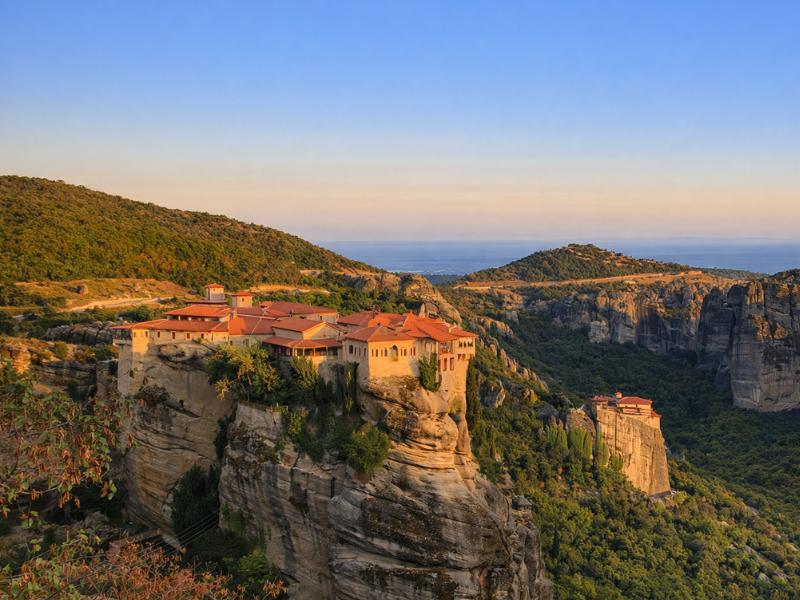
Sunset in Meteora ranges from around 17:30 in mid-January to just after 21:00 at the late-June peak. The widest practical range for planning is 17:00 to 21:30 across the year. Greece observes Eastern European Time (EET, UTC+2) in winter and Eastern European Summer Time (EEST, UTC+3) from late March to late October. The table below gives approximate sunset times by month for planning viewpoint visits and sunset tours.
Times are approximate averages for mid-month at Kalambaka (39.7°N). Actual times vary by a few minutes across the month. Verify current sunset time for your specific date before planning. Greece observes daylight saving: clocks move forward last Sunday in March, back last Sunday in October.
A practical note on golden hour duration: the longer the day, the shallower the sun’s angle at sunset and the longer the golden light lasts. June evenings at Meteora produce a golden hour that can run 45 minutes from first warm light to darkness. January evenings are quicker and colder, but the low sun angle from further south means the light hits the rock faces at a sharper angle, creating stronger contrasts between lit surfaces and shadow than summer ever produces. Winter sunset photography at Meteora, when conditions cooperate, produces some of the most dramatic images of the site.
The season you choose changes everything from prices to photo opportunities. Here’s the best time to visit Meteora tours so you show up when it counts.
| January | 17:30 | 17:00 | Short days, cold; monastery winter hours close early too |
| February | 18:00 | 17:30 | Days lengthening; fewer crowds |
| March | 18:45 | 18:15 | Clocks forward late March (EEST begins) |
| April | 20:00 | 19:30 | Summer hours activate Apr 1; good wildflower light |
| May | 20:30 | 20:00 | Long days; monasteries still open at sunset approach |
| June | 21:00-21:10 | 20:30 | Latest sunset of the year; longest golden hour window |
| July | 20:50 | 20:20 | Peak crowds; worth arriving early to secure Sunset Rock |
| August | 20:20 | 19:50 | Sunset pulling earlier; still long days |
| September | 19:30 | 19:00 | Crowds dropping; good autumn light quality |
| October | 18:30 | 18:00 | Clocks back late Oct; autumn foliage adds warmth to light |
| November | 17:15 | 16:45 | Short days, quiet; winter monastery hours from Nov 1 |
| December | 17:00 | 16:30 | Shortest days; winter atmosphere can be extraordinary if clear |
Tips for Photographing Meteora at Sunset
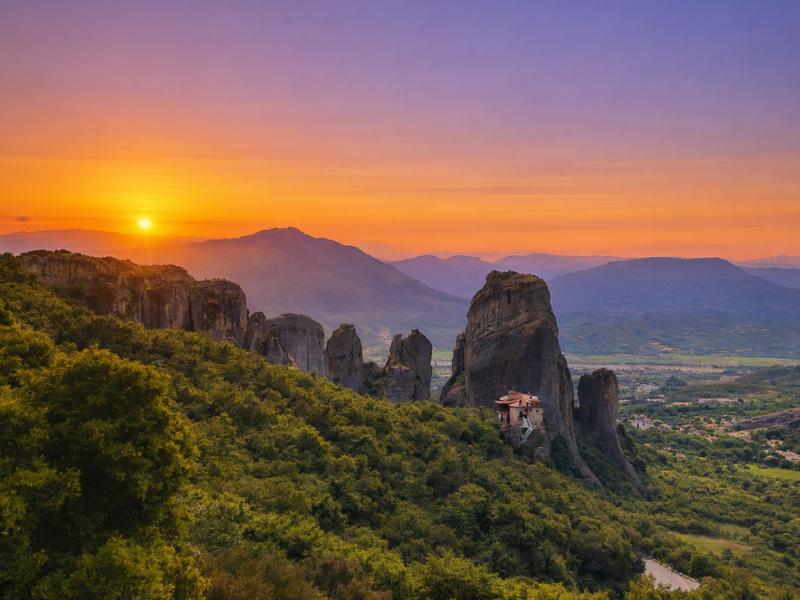
The core advice is simple: arrive before the light, not when it starts. By the time the rocks have turned amber, the best positions on Sunset Rock and the saddle viewpoint are occupied. Scout your position in neutral light, set up your composition, and wait for the light to arrive rather than chasing it. The 20 to 30 minutes of best light pass fast and camera-fumbling once they start means missing them.
Positioning at Sunset Rock: the most-photographed angle is from the top of the boulder looking south-southwest with Roussanou in the lower left third of the frame and the Varlaam-Grand Meteoron ridge filling the right two-thirds. This is a valid composition. A less photographed but often better option is to step back from the boulder edge and include the Kastraki valley below Roussanou in the lower portion of the frame, which adds depth and a sense of place that the tight monastery crop loses. The valley at sunset fills with purple shadow while the rock above it stays warm for several minutes after.
For the saddle viewpoint: a wide-angle lens or a smartphone panorama captures all five monasteries but tends to make each one small. A medium telephoto (70 to 150mm equivalent) picks out Roussanou and Varlaam together with the Grand Meteoron mass behind them in a compressed frame that emphasizes the stacking of monasteries at different distances. This is the composition that reads most powerfully as a single image.
Phone cameras: Meteora at sunset is genuinely good phone photography territory because the light is so strong and directional that even a basic sensor produces well-exposed images. The main limitation is the inability to use graduated neutral density filters, which means blown-out sky versus properly exposed rock is a common problem. The practical fix is to expose for the sky and accept the rocks at slightly underexposed. The warm tones handle underexposure better than overexposed sky. Most smartphone HDR modes handle this automatically with reasonable results.
Fog and mist: if the weather produces low cloud or mist during the day and it begins to clear toward late afternoon, stay. The window when mist is clearing from around the monastery pillars in the hour before sunset is the single most atmospheric condition the site ever produces. The monasteries appear to float above the mist layer and the light that breaks through cloud gaps hits isolated rock faces while others stay in shadow. This is unpredictable and cannot be planned. It happens several times a year, mainly in spring and autumn, and the images from those evenings look unlike any standard Meteora sunset photograph.
Use these photography tips for an independent setup. If transport between viewpoints is the harder decision, compare the available trip formats separately.
What Our Travelers Say About the Sunset Experience
| % who rated sunset as the single best moment of the Meteora visit | ~53% |
| Most visited viewpoint on guided sunset tours | Sunset Rock (Psaropetra) (~91% of tours) |
| % of day-trippers who left before sunset | ~58% |
| Most cited regret among day-trippers | “Left before the sunset” (~31%) |
| Best month for sunset light quality (guide consensus) | October (foliage + low angle + fewer crowds) |
Explore an Athens itinerary with a sunset tour and another guided morning. Staying over gives the evening its own place in the trip instead of fitting it around a same-day return.
Frequently Asked Questions
Enter your own transport, tour and accommodation amounts to compare the total cost of an independent sunset plan with a guided or overnight format.
What is the best spot to watch the sunset at Meteora?
Sunset Rock (Psaropetra lookout) is the most famous and the most visited, showing four monasteries in a single frame as the light turns amber. For a quieter and arguably better composition, the unsigned 180-degree saddle viewpoint between Grand Meteoron and Roussanou shows five monasteries at once and is almost never as crowded. Both are on the monastery circuit road and accessible by car.
Check the local sunset tour for your date before organizing separate viewpoint transfers. Pickup, transport between stops and the return to your base are included.
What time is sunset at Meteora?
It varies by month from around 17:00 in December to just after 21:00 at the late June peak. April sunset is around 20:00; October around 18:30. Arrive at your chosen viewpoint 30 to 45 minutes before sunset. Exact times shift a few minutes across the month; check a local sunrise/sunset tool for your specific date.
Return to the monthly timing table for approximate sunset and arrival windows, then verify the exact time for your travel date with a current external time source.
Is a guided sunset tour worth it?
For most first-time visitors, yes. A guided tour knows exactly where to stand at each viewpoint, which monastery to visit in the late afternoon window before closing, and how to time the arrival at Sunset Rock ahead of the crowd. The difference between arriving 40 minutes early at the right spot and arriving 10 minutes late at the wrong one is significant at peak summer. The tour also includes the Badovas caves and other stops most independent visitors miss.
Discover how monastery visits, hermit caves and sunset viewpoints fit into one four-hour route. A local guide adds the stories while the minibus handles travel between stops.
Can I watch sunset from inside a monastery?
Holy Trinity closes at 17:00 in summer, which is before sunset. The terrace and rock ledge outside the entrance gate remain accessible after closing and give a 360-degree view that includes the western monastery cluster in evening light. The monastery terraces are best for late-afternoon light rather than the actual sunset moment.
Read the Holy Trinity guide for its setting and climb before deciding whether it suits your late-afternoon plan. Verify current hours separately rather than relying on after-hours access.
What is the difference between Sunset Rock and the Main Observation Deck?
Sunset Rock (Psaropetra) faces roughly southwest and gives the best view of Roussanou and the Varlaam-Grand Meteoron ridge at sunset. The Main Observation Deck is about 400 meters south on the same road and faces south over the broader valley. Both are worth visiting; the Observation Deck is better for sunrise and for a different angle on the full rock complex. Sunset Rock is the better of the two for the classic monastery-in-golden-light composition.
For a broader overview beyond this two-viewpoint comparison, review the site guide to Meteora’s sunrise and sunset viewpoints.
Want to see the sunset without figuring out the logistics?
The small-group sunset tour departs late afternoon from Kalambaka and Kastraki, includes a monastery visit, the Badovas caves, and ends at the best viewpoint as the last light fades. See the small-group sunset tour.
Written by Michael Angelos
Greek tour guide since 2009 · Founder, Meteora Tours
Michael has guided over 14,400 travelers through the monasteries and rock formations of Meteora since founding the agency.